Learning Outcomes
i. Describe the structure and function of auditory and visual receptors in humans.
ii. Explain how these receptors contribute to maintaining balance and visual acuity.
iii. Understand the role of sensory receptors in the broader context of homeostasis.
i. Auditory Receptors
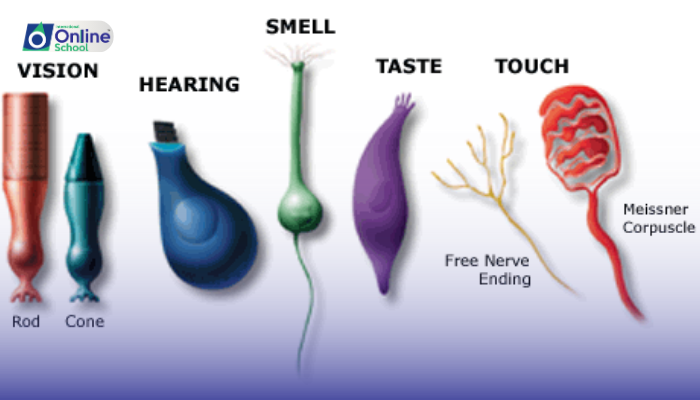
Structure: Located in the cochlea of the inner ear, hair cells are the primary auditory receptors. They are arranged in rows and are connected to the auditory nerve.
Function: These hair cells translate the mechanical vibrations from sound waves into nerve impulses that are sent to the brain, which interprets them as sound.
Balance: The vestibular system in the inner ear contains receptors that are crucial for maintaining balance. These receptors detect changes in head position and motion, sending signals to the brain to help coordinate balance and spatial orientation.
ii. Visual Receptors
Structure: Visual receptors, known as rods and cones, are located in the retina at the back of the eye. Rods are responsible for vision at low light levels, while cones are active at higher light levels and are capable of colour vision.
Function: These cells convert light into electrical signals, which are processed by the brain to produce visual images.
Visual Acuity: Cones, particularly those in the fovea centralis, the area of sharpest vision, are responsible for visual acuity and colour differentiation.
iii. Contribution to Homeostasis
Balance and Orientation: The vestibular system's role in balance is integral to an organism's ability to navigate its environment, avoid danger, and perform coordinated movements.
Visual Acuity and Perception: Sharp vision allows an organism to accurately perceive its environment, essential for finding food, avoiding predators, and interacting with others.
In conclusion, auditory and visual receptors play a critical role in maintaining homeostasis by providing essential information about the environment. The structures of these receptors are specialized to translate physical stimuli into nerve impulses that the brain can interpret, allowing for the maintenance of balance and the perception of visual cues. Understanding the function of these sensory receptors gives insight into how organisms interact with their surroundings and maintain equilibrium within their internal environment.
